Relocation
Can a Remote Video Tour Tell Me Enough to Make a Decision?
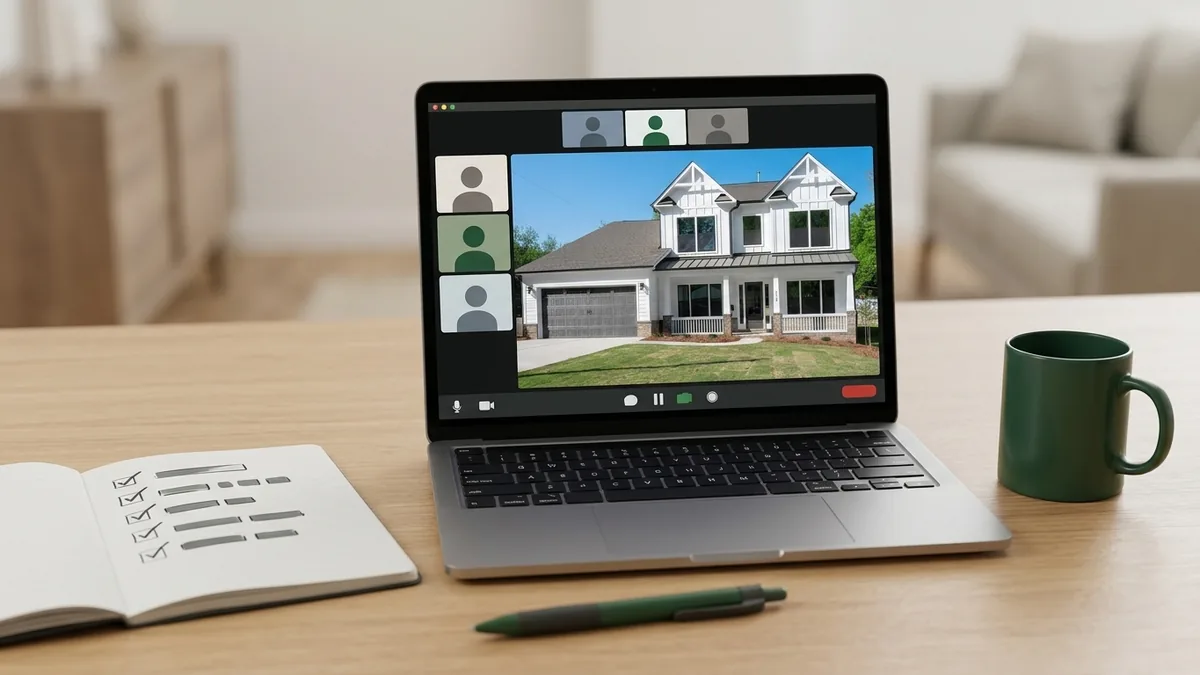
Live video tours can carry real weight in a Charlotte relocation decision, but only for certain questions.
On this page
Video Tours Have Become a Normal Part of Relocation
For an out-of-state buyer, a live video walkthrough has become a standard part of house hunting, not a substitute of last resort. If you can’t get to Charlotte before a listing you’re serious about goes under contract, a real-time video tour with your agent narrating and responding to your questions is a legitimate way to gather information. The question isn’t whether video tours are useful, it’s how much weight a specific tour can carry for a specific decision.
That weight depends heavily on what kind of tour it is. A live, agent-led walkthrough where you can ask to see the crawl space, stand in a doorway for scale, or open a closet on request is a very different tool than a pre-recorded listing video with background music. One is closer to being there; the other is closer to browsing photos with motion added.
It also depends on what you’re deciding. A live tour can tell you a great deal about layout, natural light, condition, and how a house actually flows room to room, things static photos often distort. It’s a much weaker tool for anything involving smell, sound, temperature, or the feel of a street at a different time of day than the one you happened to be watching.
What a Video Walkthrough Can Actually Show You
A good live video tour can genuinely capture how a floor plan connects, whether a kitchen faces the backyard or the street, and how much natural light a room gets at that hour. It can also catch the small physical details that matter to a lot of buyers: ceiling height, the actual size of a primary closet, whether a laundry room is upstairs or off the garage, and how steep or gentle a driveway or front walk really is.
It’s also a strong tool for narrowing between two similar listings before you commit real travel time to either one. If your agent walks you through two houses back-to-back on video, you can often eliminate one immediately, on layout or condition alone, and save your in-person trip for the one that’s still a genuine contender. That’s arguably where video tours add the most value: not replacing the final decision, but cutting the list you need to see in person.
A live tour also lets you ask real-time questions an agent can answer on the spot: what’s behind that door, how old is the roof, is that a load-bearing wall. That back-and-forth is closer to being in the house yourself than any recorded video can be, because you’re directing where the camera goes rather than watching someone else’s edit of the property.
What a Camera Can’t Tell You
What a camera consistently struggles with is scale and proportion. A wide-angle lens on a phone or a listing camera can make a small room look larger and a large room look smaller, and it’s genuinely hard to judge whether furniture will fit, or whether a hallway feels tight, from a screen. This is one of the most common places buyers get surprised when they finally walk a home they’d already toured on video.
Video also can’t carry smell, humidity, or the acoustic character of a house, and none of those are minor. A finished basement that reads perfectly fine on camera can feel damp in person. A home near a road that looks quiet in a still photo can be genuinely loud at 5pm on a weekday. These are exactly the kind of details a live walkthrough, however well done, cannot transmit.
And a camera can’t replace driving the actual route to work at a realistic hour, standing on a street to gauge traffic noise, or getting a feel for a neighborhood’s character at different times of day. Those are context questions, not property questions, and no walkthrough of the house itself answers them. If any of those matter to your decision, they need a different kind of verification than video can provide.
Getting the Most Out of a Live Video Showing
If you’re going to lean on a live video tour for a real decision, a little preparation on your end makes it far more useful. Come with a specific list of things you want the camera to show you, rather than letting the tour proceed as a generic walk-through, and don’t hesitate to ask your agent to stop, back up, or open something a second time. The value of a live tour is in the interaction, not the footage.
- Ask for a slow pass through every closet, pantry, and storage area
- Request a walk of the yard, driveway, and any shared walls or fences
- Have your agent stand in doorways or against a wall for a visual sense of scale
- Ask what’s happening just outside the frame - neighboring homes, street noise, nearby construction
It also helps to ask your agent to narrate what the camera isn’t showing you: what’s just out of frame, what the immediate neighbors’ homes look like, or what a sound you hear on the recording actually is. An agent walking a property in person has information a viewer through a screen doesn’t, and asking for it directly is the fastest way to close that gap.
Remote vs. In-Person: What Each One Confirms
It helps to think of a remote decision in two categories: what you can reasonably confirm on video, and what genuinely needs an in-person visit or a separate kind of verification. Treating everything the same, either trusting the screen completely or discounting it entirely, tends to produce worse decisions than being specific about which questions belong in which category.
| What You’re Checking | Video Tour | Needs In-Person or Direct Verification |
|---|---|---|
| Layout and flow | Generally reliable | Confirm furniture fit with measurements |
| Natural light | Reliable at time of day shown | Check at different times of day |
| Smell, humidity, dampness | Cannot detect | Requires an in-person walk-through |
| Street noise and traffic | Unreliable on camera | Drive the route at a realistic hour |
| Structural or system condition | Visual only | Confirm with inspection, not video |
The table below isn’t an exhaustive list, but it reflects the kinds of questions that come up most often for out-of-state buyers weighing whether a video tour is enough on its own, or whether a specific detail is worth confirming another way before an offer goes in.
When a Video Tour Is Enough to Decide
Whether a video tour is enough to actually decide on a home depends less on the technology and more on your own tolerance for risk and what’s driving your timeline. Some buyers are comfortable moving forward on a strong video tour paired with an honest conversation, particularly when they trust the agent’s read on the property and the timeline doesn’t allow for a trip before the home is likely to go under contract.
Others want to see a home in person before writing an offer, full stop, and that’s a reasonable position too. There’s no universally right answer here, and an agent who tells you sight-unseen is always fine, or never fine, is giving you a generic answer instead of one built around your specific situation, your risk tolerance, and the property in question.
Before You Rely on a Screen Alone
If you do move forward without an in-person visit, it’s worth building in protections that don’t depend on the video tour alone. An inspection contingency matters more, not less, when you haven’t walked the property yourself, and it gives you a professional, in-person set of eyes on exactly the things a camera can’t reliably show you.
- Keep the inspection contingency in place, even on a strong video tour
- Ask your agent for a follow-up call after the tour, not just the recording
- Confirm anything smell, sound, or humidity related with a trusted in-person source if possible
- Treat the tour as narrowing your decision, not necessarily finishing it
The larger point is that a video tour is a real tool, not a compromise you settle for. Used well, with the right preparation and the right questions, it can carry a genuine share of the decision. It just shouldn’t be asked to carry all of it without a plan for confirming the parts it structurally can’t show you.
This article is general information about relocating to the Charlotte region, not legal, tax, or financial advice. Confirm state-specific requirements with the appropriate agency or licensed professional.

Written by